
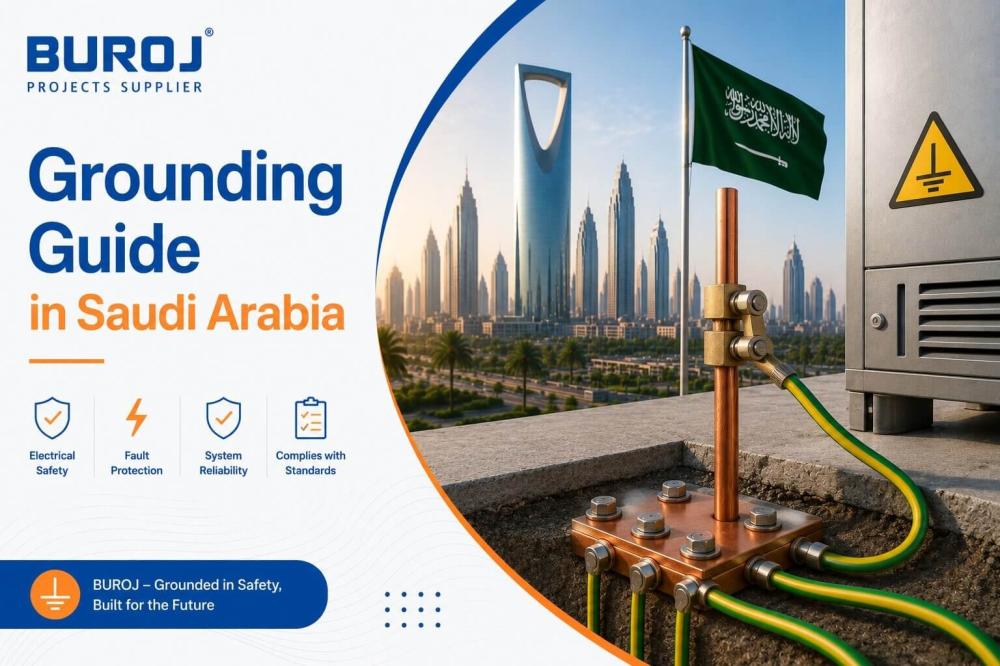
The difference between earthing and grounding is one of the most frequently misunderstood topics in electrical engineering across Saudi Arabia. Both involve connecting an electrical system to the earth, but they serve distinct technical functions governed by separate IEC standards. For contractors, engineers, and procurement teams, applying each concept correctly is critical to SEC compliance, personnel safety, and long-term system reliability on every project, residential, commercial, or industrial.
What is Earthing and Grounding?
Both earthing and grounding create a physical connection between an electrical installation and the earth, but they operate at different levels of a system. Misapplying the terms of the IEC-standard Saudi projects can lead to non-compliant specifications, failed SEC inspections, and genuine safety risk.
What is Earthing?
Earthing is the direct connection of non-current-carrying metallic parts, equipment enclosures, cable trays, motor frames, and switchgear housings to the earth. When a live conductor contacts a metal enclosure due to insulation failure, the earthing system provides a low-impedance fault current path to the ground. This causes protective devices such as RCDs and circuit breakers to trip within milliseconds, eliminating dangerous touch voltage on exposed surfaces.
In Saudi Arabia, earthing is mandatory under IEC 60364-5-54 and SEC distribution standards. It applies across all building wiring systems, high-voltage substations, and industrial plants. Earth resistance targets are below 1 ohm for substations and below 5 ohms for general LV installations.
What is Grounding?
Grounding, as defined in North American NEC terminology, primarily refers to system grounding: the intentional connection of a current-carrying conductor (typically the neutral) to earth at the source. This establishes a stable voltage reference for the entire distribution network, prevents floating neutral conditions, and enables correct operation of protective relays.
In Saudi Arabia, both IEC and NEC terminology appear on mixed-nationality projects. Understanding the difference between earthing and grounding prevents specification conflicts when American-spec equipment operates alongside IEC-standard installations. Low-voltage cables with integrated neutral and protective earth conductors form the distribution backbone of a correctly grounded system.
Key Difference Between Earthing and Grounding
The difference between earthing and grounding comes down to what is connected, why it is connected, and which standard governs it. Understanding this distinction prevents critical design errors on Saudi MEP projects:
- Purpose: Earthing is a safety function; it provides a fault current path and prevents electric shock. Grounding is a system stability function that establishes a voltage reference at the source.
- Connection object: Earthing connects non-current-carrying metal parts (enclosures, frames, trays). Grounding connects the neutral conductor, a current-carrying conductor, to earth at the source.
- Application level: Earthing is applied at the installation level on every piece of equipment. Grounding is a system-level decision at the source transformer or generator.
- Terminology by standard: 'Earthing' is the IEC term used in Saudi Arabia, the UK, and Europe. 'Grounding' is the NEC equivalent for North American engineering practice.
- Governing standards: Earthing: IEC 60364, IEC 62305. Grounding: IEC 60038, NEC Article 250.
The core difference between earthing and grounding is that earthing protects people, while grounding protects the system. Both are required in a fully compliant Saudi electrical installation.
Need Help Choosing the Right Earthing System?
El Buroj provides complete earthing solutions in Saudi Arabia, including system design, material supply, site implementation, and compliance support for commercial, industrial, and infrastructure projects.
Request a consultation today via WhatsApp or call 920031298.
Technical Comparison Table: Earthing vs. Grounding
The table below summarises the difference between earthing and grounding across the key technical parameters relevant to Saudi Arabia projects:
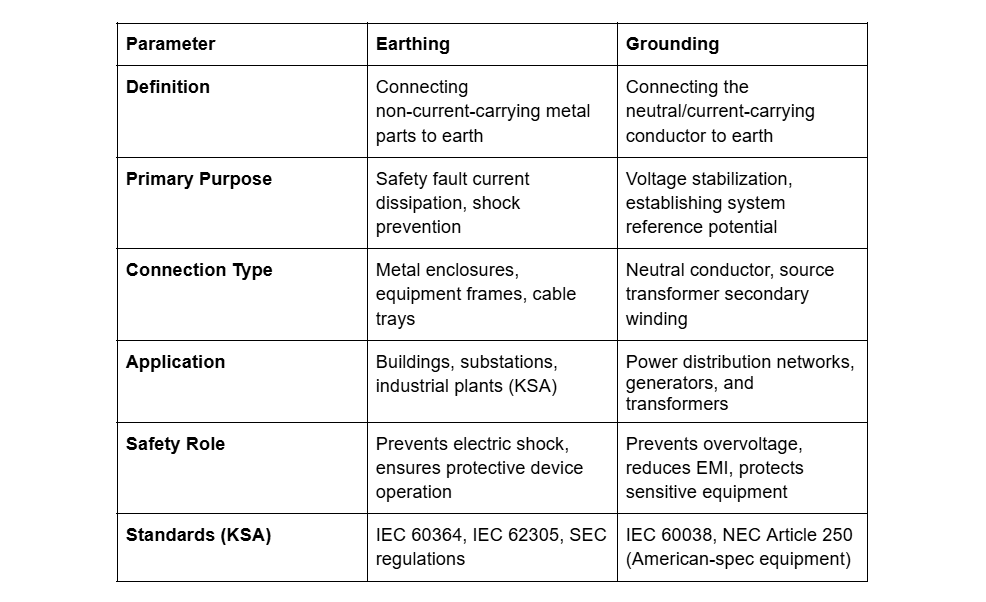
- Earthing refers to connecting non-current-carrying metal parts such as equipment frames, cable trays, and enclosures directly to the earth to safely dissipate fault current and prevent electric shock. It is widely used in buildings, substations, and industrial facilities across Saudi Arabia and follows standards such as IEC 60364, IEC 62305, and SEC regulations.
- Grounding refers to connecting the neutral or current-carrying conductor to earth to stabilize system voltage and establish a reference potential for the electrical network. It is commonly applied in transformers, generators, and power distribution systems to reduce overvoltage, minimize electromagnetic interference (EMI), and protect sensitive equipment, following standards such as IEC 60038 and NEC Article 250.
Why Earthing and Grounding Are Important in Electrical Systems
Correctly implementing the difference between earthing and grounding in project design is not optional. IEC standards and SEC regulations mandate both functions for every licensed electrical installation in the Kingdom.
Personnel safety is the primary driver. Without a low-impedance earthing path, a fault on live equipment energizes exposed metalwork indefinitely. Protective devices cannot operate correctly without this return path, an invisible hazard that passes visual inspection but fails catastrophically under real fault conditions.
Equipment protection is equally critical. Voltage transients, lightning surges, and switching events damage sensitive equipment in the absence of proper grounding. Specifying XLPE cables with integrated shielding and terminating all metalwork at properly rated electrical panels reduces surge-induced failures across the entire installation.
From a compliance standpoint, SEC project specifications require IEC-compliant earthing on all licensed installations. Integrating safety systems and low-current system infrastructure alongside the primary earthing network ensures full-spectrum protection and prevents costly rejection during inspection.
How to Choose the Right Earthing and Grounding System
Selecting the correct configuration requires site evaluation before design. The primary factors that determine the right earthing and grounding system for Saudi projects are:
1. Soil Resistivity:
Saudi Arabia's terrain ranges from low-resistivity coastal soils in the Eastern Province to high-resistivity rocky ground in the Hejaz region. High-resistivity conditions require chemical earthing compounds, deep-driven ground rods, or expanded electrode networks to meet the IEC 60364 resistance targets.
2. Project Type:
- Residential: TN-S or TT arrangement with a single electrode at the main distribution board.
- Commercial: Bonded earthing across multiple boards with equipotential bonding of all metallic services.
- Industrial / petrochemical: Full earthing grids, IEC 62305 lightning protection, and zone-by-zone resistance testing.
3. Load Characteristics:
Installations with VFDs, data centre infrastructure, or sensitive instrumentation require clean grounding with minimal impedance. Correct conductor sizing using high-quality electrical wires is essential for system integrity under all load conditions.
4. Environmental Conditions:
Extreme heat, coastal humidity, and salt-laden soils accelerate electrode corrosion in Saudi Arabia. Copper-clad steel rods and tinned earthing conductors are the recommended specification for the majority of Saudi sites.
Need Help Choosing the Right Earthing System?
El Buroj provides complete earthing solutions in Saudi Arabia, including system design, material supply, site implementation, and compliance support for commercial, industrial, and infrastructure projects.
Request a consultation today via WhatsApp or call 920031298.
Shop Earthing and Grounding Materials at El Buroj
El Buroj stocks a complete range of IEC-certified materials for earthing and grounding installations across Saudi Arabia. Engineers and contractors sourcing the difference between earthing and grounding applications from protective earth conductors to panel bonding accessories will find project-ready stock available for immediate dispatch.
- The earthing electrode range includes the 3/4" copper-bonded earth rod 1500mm and the Furse copper earthing rod RB 19x1500mm, both designed for driven-rod installations in Saudi soil conditions, offering high conductivity and corrosion resistance across the full service life of the system.
- For conductor connections, El Buroj stocks the Furse earthing tape clamp CP210-H 25x3mm for secure tape-to-tape bonding in earthing networks, and the rod-to-cable clip-on clamp CR520 35-95mm for connecting earthing conductors directly to driven rods. Both are manufactured from high-conductivity copper for minimal contact resistance.
- For permanent, maintenance-free joints on buried connections in industrial and substation earthing grids, El Buroj supplies the Furse exothermic welding powder 90P10, creating irreversible molecular-bonded connections with no mechanical components to corrode over time.
- The conductor range includes IEC-coded yellow/green earthing cables for protective earth (PE) conductor runs across all project types.
Browse the full El Buroj earthing products range for the complete selection of earthing electrodes, conductors, clamps, and accessories.
Why Choose El Buroj for Earthing Systems?
El Buroj provides both design and supply for earthing and grounding systems supporting MEP contractors, electrical engineers, and procurement teams from specification through to site delivery.
Whether you need a fully designed earthing solution or direct supply of IEC-certified materials, El Buroj handles both under one point of contact.
- Design and Supply: El Buroj supports projects from earthing system design, including soil resistivity assessment, electrode configuration, and resistance calculation, through to full material supply.
- Standards Compliance: All products meet IEC certification and are suitable for SEC-regulated projects, eliminating compliance risk from unverified suppliers.
- Nationwide Delivery: El Buroj delivers across Riyadh, Jeddah, Dammam, Khobar, Mecca, and Medina with logistics scaled for full MEP and construction packages.
- Technical Support: El Buroj's team provides guidance on conductor sizing, earth resistance targets, and compliance documentation from specification through delivery.
Need Help Choosing the Right Earthing System?
El Buroj provides complete earthing solutions in Saudi Arabia, including system design, material supply, site implementation, and compliance support for commercial, industrial, and infrastructure projects.
Request a consultation today via WhatsApp or call 920031298.
FAQs About the Difference Between Earthing and Grounding
What is the difference between earthing and grounding?
The difference between earthing and grounding is that earthing connects non-current-carrying metal parts to earth for safety, while grounding connects the neutral conductor to earth to stabilize system voltage. IEC standards use 'earthing'; NEC standards use 'grounding.'
Is earthing the same as grounding?
Not exactly. In IEC terminology, earthing refers to the safety connection of equipment metal parts to earth. Grounding in NEC terminology includes both system grounding (neutral to earth) and equipment grounding. The functions overlap, but the terminology and scope differ by standard.
Why does the difference between earthing and grounding matter in Saudi Arabia?
Saudi Arabia follows IEC standards, so 'earthing' is the correct term in SEC documentation. However, 'grounding' appears in American-spec equipment manuals on mixed projects. Knowing the difference between earthing and grounding prevents specification errors and compliance failures on these projects.
What is bonding and grounding?
Bonding and grounding means connecting all metallic components, pipes, cable trays, structural steel, and equipment enclosures to a common earth reference. Bonding eliminates potential differences between surfaces, preventing arcing and touch voltage risk across the full installation.
Can a system work without earthing?
Technically, yes, but it is unsafe and non-compliant. Without earthing, a fault on live equipment can energize exposed metal indefinitely. Understanding the difference between earthing and grounding makes it clear why both functions are required; omitting either creates a hazard that protective devices cannot resolve.
What earth resistance is required in Saudi Arabia?
Per IEC 60364 and SEC specifications: below 1 ohm for high-voltage substations and below 5 ohms for general LV installations. Facilities with sensitive instrumentation may require values at or below 0.5 ohms.
What materials are used for earthing electrodes in Saudi Arabia?
Copper-clad steel rods are the standard specification due to corrosion resistance in Saudi Arabia's high-temperature and high-salinity soil conditions. Solid copper rods, tinned stranded conductors, and copper plates are also used, depending on site soil chemistry and project specification.